Pontius Pilate by Aldo Schiavone
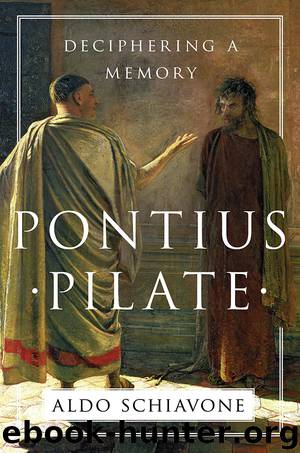
Author:Aldo Schiavone
Language: eng
Format: epub
Publisher: Liveright
PILATE LEAVES JESUS, THEN, and once again steps outside the Praetorium, toward the waiting priests. The sun must by now have been high in the sky. Difficult hours lay ahead.
4
THE DESTINY OF THE PRISONER
1.
The dialogue with Jesus was accompanied, now, for Pilate, by discussion with the Jewish notables gathered in front of the palace. An unexpected situation had arisen, brought about by the conduct of the prisoner, the answers he had given, and the force— evidently perturbing—of his personality. Pilate was no longer ready to accept the guilt of the man under investigation—as perhaps he had been preparing to do—and had decided to inform his accusers of this. Before going outside, did he tell Jesus about the view forming in his mind? Was the latter aware of the governor’s inclination? We cannot say, but it is hard to believe—even supposing silence or reticence on the prefect’s part—that he did not intuit anything, did not realize that the interrogation was taking a different and, for his accusers, unfavorable turn. How would Jesus have reacted to the direction in which things were going? Heart-ened, perhaps, like someone who sees the dense clouds over his head suddenly thinning out? It is a crucial question—as we shall see—but for the time being we will leave it in abeyance.
Pilate now addresses the Jews: “I find no reason to condemn him,” he says, in John, while Luke is even more detailed: “You brought me this man as one who was perverting the people; and here I have examined him in your presence and have not found . . . any of the reasons for which you accuse him.” (We should not be deceived by that “in your presence”— enópion ymôn: it does not necessarily mean that Pilate carried out his interrogation in front of the accusers—contradicting John’s version—but simply that the inquiry had been conducted while the Jews were waiting outside. Luke’s reference to the prefect “[calling] together the chief priests, the elders, and the people,” would make no sense if they were all already there.)
Pilate’s statement was interlocutory, and not a verdict. It communicated an orientation rather than a decision. Jesus was still in the Praetorium, and the questioning could be resumed at any moment, as in fact it soon would. Could the prefect have gone further and released the prisoner? Of course: he was quite within his powers. But he decided not to, so as not to force the situation. His relations with Annas and Caiaphas were delicate and complex; Judaea was a difficult country; and he knew perfectly well that he was on a razor edge. But even so, his declaration came as a complete surprise to the members of the Sanhedrin, especially to the two high priests, after the negotiations preceding the arrest, which had been expedited with Roman collaboration, and after the hurried nighttime meeting in Annas’s house.
A stalemate was forming, charged with a tension we can readily imagine. The governor’s words, though cautious, were strong, and there was the risk of arriving at a point of no return.
Download
This site does not store any files on its server. We only index and link to content provided by other sites. Please contact the content providers to delete copyright contents if any and email us, we'll remove relevant links or contents immediately.
Fanny Burney by Claire Harman(26574)
Empire of the Sikhs by Patwant Singh(23047)
Out of India by Michael Foss(16832)
Leonardo da Vinci by Walter Isaacson(13262)
Small Great Things by Jodi Picoult(7092)
The Six Wives Of Henry VIII (WOMEN IN HISTORY) by Fraser Antonia(5471)
The Wind in My Hair by Masih Alinejad(5063)
A Higher Loyalty: Truth, Lies, and Leadership by James Comey(4927)
The Lonely City by Olivia Laing(4777)
The Crown by Robert Lacey(4776)
Millionaire: The Philanderer, Gambler, and Duelist Who Invented Modern Finance by Janet Gleeson(4433)
The Iron Duke by The Iron Duke(4331)
Papillon (English) by Henri Charrière(4232)
Sticky Fingers by Joe Hagan(4157)
Joan of Arc by Mary Gordon(4069)
Alive: The Story of the Andes Survivors by Piers Paul Read(4003)
Stalin by Stephen Kotkin(3927)
Aleister Crowley: The Biography by Tobias Churton(3613)
Ants Among Elephants by Sujatha Gidla(3446)
